5 Signs Your Business Needs Process Optimization
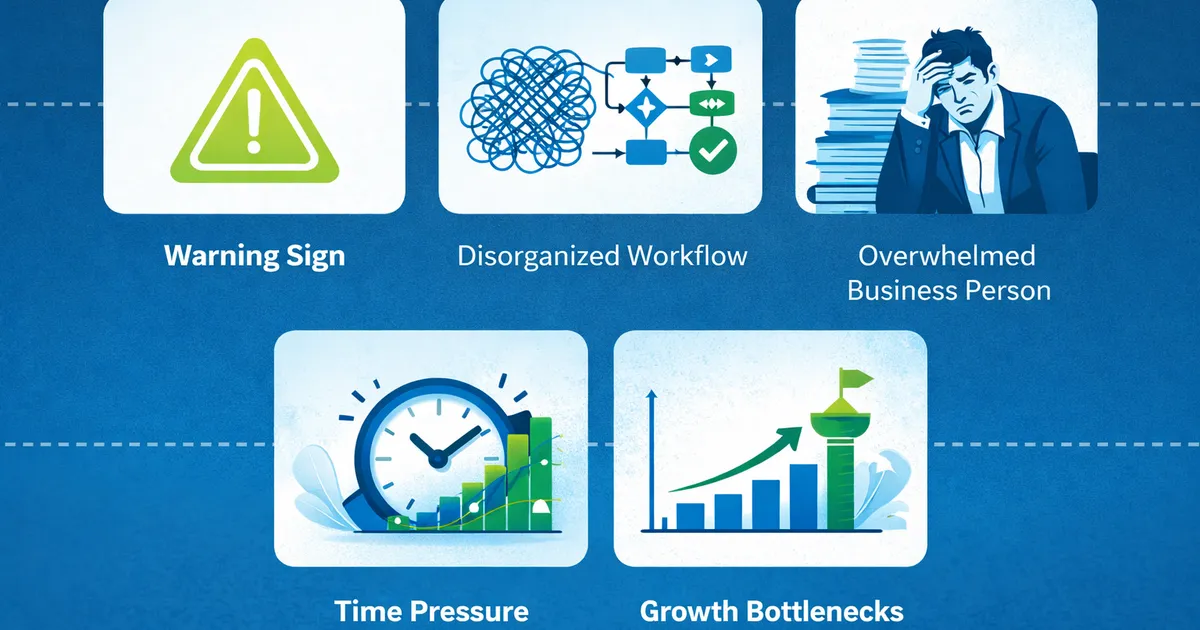
Growing businesses hit a breaking point where old processes crack under pressure.
Sound familiar? You’re working longer hours, struggling to keep up, and missing opportunities you know you should be taking.
Here are 5 clear signs that process optimization isn’t optional anymore—it’s essential.
Sign 1: You’re Drowning in Admin Instead of Leading Your Business
Reality Check: If you’re spending more than 10-15 hours per week on admin tasks, you have a process problem, not a time management problem.
You’re stuck playing catch-up with invoicing. Manual data entry is eating into your weekends. “Quick tasks” somehow take hours. And you can’t take time off without everything falling apart.
This isn’t sustainable. When you’re buried in administrative work, you’re not doing the strategic thinking that actually grows your business.
Sign 2: Every Team Member Does Things Differently
Reality Check: Ask three people how to complete the same task. If you get three different answers, you have no standardization.
The warning signs are everywhere. New hires take months to become productive because there’s no clear process to follow. Quality varies wildly depending on who does the work. Your team constantly asks “how do I…?” for things that should be routine.
The biggest risk? Critical knowledge exists only in one person’s head. When they’re on holiday or leave the company, that expertise walks out the door with them.
Sign 3: You’re Saying No to Growth Opportunities
Reality Check: When your growth is limited by operations rather than demand, your processes are broken.
You’re declining projects because you’re “too busy.” Client waiting lists are getting longer. The thought of 50% growth terrifies you because you know something will break.
You’ve hit your ceiling—not because the market isn’t there, but because your operations can’t handle it.
Sign 4: Simple Tasks Take Way Too Long
Reality Check: When a 10-minute task takes an hour, you’re losing 85% efficiency.
Think about your daily workflow. You’re constantly switching between multiple tools. Copying the same data between different systems. Chasing down information that should be at your fingertips. Redoing work because of miscommunication. Fixing errors that shouldn’t have happened in the first place.
Each interruption compounds. What should be straightforward becomes a time-consuming ordeal.
Sign 5: Growth Is Breaking Your Business
Reality Check: If doubling your revenue would break everything, your business isn’t scalable.
As you grow, things are getting more chaotic—not less. Communication breakdowns are becoming routine. Projects slip through the cracks more frequently. Client satisfaction is starting to decline.
Growth should make your business stronger and more efficient. If it’s making things worse, your processes can’t scale.
What to Do Next
If you recognized your business in three or more of these signs, it’s time to invest in process optimization.
The good news? Even small improvements can yield significant results. You don’t need to overhaul everything at once.
Start With These Five Steps:
1. Document your current processes. You can’t improve what you don’t understand. Map out how work actually gets done today.
2. Identify your biggest bottlenecks. Where do things slow down? Where do errors happen? Where does work pile up?
3. Prioritize improvements based on impact. Focus on changes that will save the most time or have the biggest effect on quality.
4. Implement changes systematically. Roll out improvements one at a time so you can measure what works.
5. Measure results to prove ROI. Track time saved, errors reduced, and revenue opportunities captured.
Don’t wait until process problems become business crises.
The best time to streamline your operations was yesterday. The second best time is now.
Ready to optimize your processes?
Calculate your potential ROI or get in touch to discuss how we can help streamline your business for scalable growth.
About Rachel
Helping small to medium businesses streamline operational processes for growth through process improvement, workflow optimization, and system integration.